As part of the observance of the 150th anniversary of the Civil War, the Diocese of Mississippi co-sponsored a symposium held at Trinity Episcopal Church in Natchez, Mississippi to explore a violent and little understood local episode in the history of Adams County: an 1861 slave uprising at the very beginning of the Civil War which resulted in vigilante trials and the hanging deaths of 40 slaves.
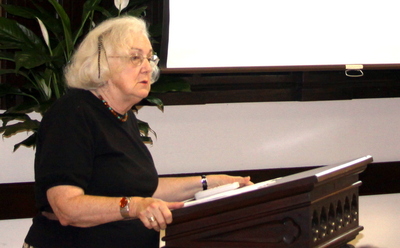 |
| Dr. Elizabeth MacNeil Boggess |
A panel of four history professors and one archeologist/historian presented papers for the one day event entitled, No more Silence at Second Creek: Slave Resistance and the Onset of the Civil War. The initial research began with the 1993 book Tumult and Silence at Second Creek, by Dr. Winthrop Jordan. Since Jordan’s initial work at the University of Mississippi, many other scholars have researched slave resistance and rebellion in Mississippi.
While events surrounding the Second Creek uprising are still shrouded in mystery, Dr. Elizabeth Boggess, an archeologist/historian, and one of the presenters at the symposium, says that the conspiracy began on April 14, 1861. On that day, Confederate troops from Natchez left the city to join in the Civil War. It was only one day after Union troops surrendered Fort Sumter to the Confederacy in Charleston Harbor.
By July of 1861, after the First Battle of Manassas (Bull Run) white people were beginning to learn of the conspiracy according to Kathleen Jenkins, the Superintendent of the Natchez National Park and member of Trinity Church in Natchez. Jenkins says that “talk began to spread among people in the plantations of the Second Creek area southeast of Natchez regarding enslaved men rising up to fight the white people and blacks who would not join them; to kill their masters and mistresses and ravish the young ladies in return for past whippings, overworking and even killings.”
It was at this point that James Surget, the great grandfather of two surviving sisters living in Natchez today, was caught up in vigilante justice that led to the first hangings of slave conspirators.
The first 10 hangings took place on September 24, 1861 at Cherry Grove and Brighton Woods plantations. In the coming weeks, 30 more hangings took place on land owned by James Surget who, after the war, become a regular member of Trinity Church.
Two surviving Surget family members are Dr. Elizabeth Boggess, mentioned above, and Anne MacNeil, a member of Trinity Church. The two women are sisters and are both active in historical preservation efforts.
“My great grandfather, James Surget, would have been about 25 years old at the time of the uprising. He was the Captain of the Home Guard and it was his job to arrest the conspirators and execute them,” said Boggess.
“This was not like a war situation where people are shot in the heat of battle. The hangings completely changed his life. He undoubtedly grew up with the same people he executed. It shook his personal beliefs.”
After the war, Boggess says that Surget lost all his livestock and feed crops (he wasn’t a cotton farmer), but he systematically restored his land as well as offering reparations for the wrongs he did. “He also gave away tremendous amounts of land to the tenant farmers who worked on his property,” said Boggess. “After the war, he became a devout Episcopalian at Trinity Church in Natchez.” Prior to the war, Boggess believes her great grandfather didn’t attend church often.
Boggess and her sister, Anne MacNeil, are not native Mississippians. Both grew up in Princeton, New Jersey where their father was a career civil servant for the city. Their paternal grandfather was an Episcopal priest serving small churches in upstate New York.
The two women often visited Natchez, which was the home of their mother, but neither was exposed to ethics of Jim Crow South. Both women have lived in Natchez for many years and feel a deep love and commitment to the community. The symposium, which the sisters helped organize, is one way of offering their service.
“We know our history, and we do not believe in keeping it as secret,” said Dr. Boggess. “We hope that our work, and the research of others, opens communications between people.”
MacNeil says she’s wrestled with the truth of her family’s involvement in the Second Creek tragedy. The Rev. Chip Davis, a former rector of Trinity Church helped her come to terms with the role her family played. She also found spiritual nurture over the years through participating in EFM (Education for Ministry) and the DOCC program (Disciples of Christ in Community).
“For me, it’s all about how we treat each other as human beings. Do I respect the dignity of all people? There is nothing I can do about my great grandfather’s actions, but I can do something about how I live my daily life and my interactions with other people.”
The Second Creek slave uprising ended with 40 hangings; however, the incident was part of a much larger reaction. It is estimated that by the time Union troops occupied Natchez in July of 1863, as many as 200 slaves were killed.
One of the presenters at the symposium was Dr. Edward L. Bond. Bond is the editor of Anglican and Episcopal History, the journal of the Historical Society of the Episcopal Church, and said that this the third symposium held in regards to slavery and the Episcopal Diocese of Mississippi. The work comes as a response to General Convention Resolution 2006-A123. Bond is at the forefront of this research in the state.
“I think that the commitment of Trinity Episcopal Church, Natchez and the Diocese of Mississippi’s ongoing project to unearth the truth about church history and slavery, allows us to begin the process of healing. There cannot be healing without truth-telling first,” said Kathleen Jenkins.